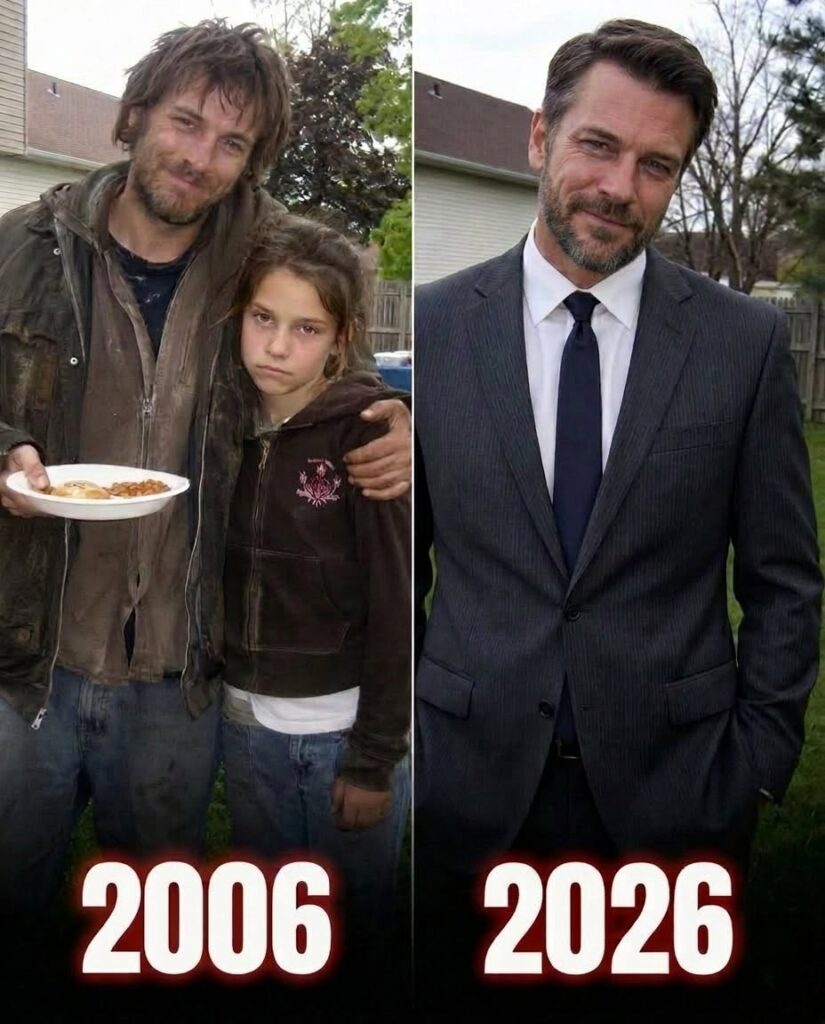
For twenty years, I believed my mother had chosen a homeless man over me.
I believed that every container of food she carried out the back door was proof that she cared more about Victor than her own daughter. I believed he was just some stranger living behind our house in a shelter made from tarps, old wood, and whatever scraps he could find….
Even after Mom died, I only kept feeding him because I had promised her I would.
Then one day, Victor placed my mother’s missing silver locket in my hands.
And everything I thought I knew about my life fell apart.
The day after my mother’s funeral, I returned to her small house with a container of beef stew balanced in my hands. The house looked the same from the outside, but it felt hollow now, as if grief had emptied every room before I even opened the door.
Victor’s shelter stood behind the fence where it always had.
Except this time, it was empty.
The blanket was folded neatly.
The coffee cans were gone.
The firewood was stacked.
For the first time in as long as I could remember, Victor was not there.
“Victor?” I called.
A voice answered from behind me.
“Fiona.”
I turned and froze.
Victor stood near the back steps, but he didn’t look like the man I had known all my life. His beard was trimmed. He wore a clean dark coat. Beside him was a black SUV.
And in his hand was my mother’s silver locket.
The same locket she had told me vanished when I was eight years old.
My fingers tightened around the food container.
“Where did you get that?”
Victor looked down at the locket as if it weighed more than metal ever should.
“Your mother gave it to me.”
“No,” I said immediately. “That was lost.”
His tired eyes lifted to mine.
“No, Fiona. She told you it was.”
A cold feeling moved through me.
For most of my childhood, Victor had lived behind our rental house. Not inside it. Not properly part of it. Just close enough to be seen, but far enough away to stay unexplained.
Every afternoon, Mom packed three meals.
Two stayed on our kitchen table.
The third went into a plastic container for him.
I hated that container.
I hated the way she always gave him the softest bread, the biggest piece of chicken, the extra blanket when winter came early.
We were poor too.
Our lights were shut off twice one winter.
My sneakers had tape over the holes.
But Victor always ate.
When I was eleven, I finally said what had been burning inside me.
“He eats better than I do.”
Mom went still at the stove.
“Fiona, don’t start.”
“Why not?” I snapped. “We barely have enough, but Victor gets lunch every day like he’s family.”
The spoon slipped from her hand and clanged into the sink.
“Don’t say his name like that.”
“Like what?”
“Like he’s nothing.”
I crossed my arms.
“He’s just some man behind our house.”
Her face changed then.
The color drained from it.
“No,” she whispered. “He isn’t just some man.”
For one second, I thought she was finally going to tell me the truth.
Instead, she pressed the warm container into my hands.
“Take him his food.”
I stared at her.
“Maybe if you stopped feeding strangers, we wouldn’t live like this.”
Mom slammed her palm against the counter so hard I jumped.
“Don’t ever say that again.”
Her voice shook.
“You have no idea what that man gave up.”
“For who?” I demanded. “You?”
She turned away from me.
“Take him his food, Fiona. This conversation is over.”
So I took it.
Victor was sitting near the fence, rubbing his hands together for warmth.
“Your mom make soup today?” he asked.
“Chicken.”
A soft smile touched his face.
“That’s her best one.”
“You don’t even know her.”
The smile vanished.
“I know her soup.”
For some reason, that made me hate him more.
Years passed.
I moved out.
I built a life of my own.
Mom and I argued less because I stopped asking questions.
But Victor never left.
Sometimes I saw him fixing a loose porch step.
Sometimes I noticed firewood stacked neatly after storms.
Once, when my winter boots split open in high school, a used pair appeared beside my backpack.
“Where did these come from?” I asked.
“Church donation,” Mom answered too quickly.
When I looked out the window, Victor was brushing snow from our steps.
None of it ever made sense.
Then cancer came for my mother.
It shrank her slowly, stealing the strength from the woman who had once carried grocery bags in both hands and opened doors with her elbows.
Near the end, she grabbed my wrist from her hospital bed.
“Fiona,” she whispered.
“I’m here.”
“You have to promise me something.”
I leaned closer.
“Anything.”
“Victor.”
I closed my eyes.
“Mom, please.”
“Promise me you’ll feed him.”
“Why?” I whispered. “Why always him?”
Her eyes filled with tears.
“I never put him before you.”
“It felt like you did.”
“I know.”
Her voice broke.
“And I’m sorry.”
“Then tell me why.”
She glanced toward the doorway, frightened even from her hospital bed.
“If Mark comes around after I’m gone, don’t let him touch the blue box.”
“Uncle Mark?”
“Promise me.”
“What does Mark have to do with Victor?”
Her grip tightened.
“He’ll erase him completely.”
“Erase who?”
“Just promise me, Fiona.”
I wanted answers.
But she looked terrified.
So I promised.
A few days later, she was gone.
After the funeral, relatives filled her house with quiet voices, casseroles, and sympathy that already felt rehearsed. Uncle Mark stood near the hallway, calmly sorting through boxes like he owned the grief in the room.
“What are you doing?” I asked.
“Helping.”
“By going through her things?”
He smiled gently.
“Your mother kept too much. Old papers. Broken things. Sad memories.”
“I’ll decide what stays.”
His smile tightened.
“You’re grieving. This isn’t the time to make emotional choices.”
I looked toward the back window.
Victor’s shelter sat beyond the fence.
“Funny,” I said. “Mom warned me about you.”
Mark’s hand froze.
“What did Stephanie say?”
“She said if you came around, I shouldn’t let you touch the blue box.”
For a split second, his face changed.
Then he laughed.
“She was sick, Fiona.”
“She was scared.”
“Of me?”
“You tell me.”
His voice dropped.
“Leave old pain buried.”
The next morning, I made stew because it was the only thing I knew how to cook without ruining it. I packed it into one of Mom’s old containers and drove back.
That was when I found Victor standing beside the SUV.
Mrs. Bell, our neighbor, stepped out from the driver’s side.
“Borrowed from my nephew,” she said. “Victor wanted to visit your mother’s grave before Mark caused trouble.”
I barely heard her.
My eyes were on the locket.
“Why would my mother give you that?” I asked.
Victor opened it with trembling fingers.
Inside was an old photograph of two children sitting on porch steps.
A little girl with scraped knees.
A boy with one arm wrapped protectively around her shoulders.
On the back, in childish handwriting, were three words.
My safe place.
“That’s Mom,” I whispered.
Victor nodded.
“And the boy?”
“Me.”
“No,” I said. “Mom only had one brother.”
“Mark was the youngest.”
My voice rose.
“You’re lying.”
“I wish I was.”
“If you were her brother,” I said, “why were you living outside?”
Victor flinched.
Mrs. Bell answered for him.
“Because Mark scared her.”
The words made my stomach twist.
“He told Stephanie people would call her unfit if she let Victor near you. She was poor, raising you alone, and terrified someone would take you from her.”
Victor closed the locket.
“She kept me close the only way she thought she could.”
Suddenly, Mom’s final words made sense.
The blue box.
I ran inside.
I tore through her closet until I found it beneath a stack of old blankets.
My name was written across the lid.
Inside were photographs, envelopes, and a letter addressed to me.
My hands shook as I opened it.
Mom’s words blurred through my tears.
Victor was my brother before he was anything else.
She wrote that he had walked her to school, given her the warm blanket when there was only one, and once tried to sell their mother’s bracelet — not for himself, but to buy blankets when the pipes froze and the house had no heat.
But the family never forgave him.
Especially Mark.
Mark called him a thief for years.
Then Victor got sick, struggled, and became the person the family had already decided he was.
Mom wrote that Mark used Victor’s shame against her.
He told her that if she let Victor near me, people would question whether she was fit to raise a child.
And she believed him.
So she made the worst bargain of her life.
She kept Victor alive.
But she let me think he was a stranger.
By the time I finished reading, I could barely breathe.
I carried the box back to the living room just as Mark walked in through the front door.
He saw it immediately.
“Give that to me.”
“No.”
His expression hardened.
“Fiona, you don’t understand.”
“I understand enough.”
Victor stepped in behind me.
Mark’s face turned cold.
“Get him out.”
I moved between them.
“His name is Victor. He’s Mom’s brother.”
Aunt Linda gasped from the hallway.
“What?”
Mark snapped, “This is none of your concern.”
I lifted Mom’s letter.
“She wrote everything down.”
The room fell silent.
“You threatened her. You used her poverty against her. You made her believe loving her brother could cost her daughter.”
“I protected this family,” Mark said.
“No,” I replied. “You protected the version where Victor didn’t exist.”
Victor’s voice trembled, but he stood tall.
“I chose Stephanie when you chose appearances.”
Mark looked around the room, searching for support.
He found none.
Aunt Linda stepped forward, her face pale.
“You told us he was dead.”
Mark swallowed.
“That was easier.”
“Easier for who?” I asked.
No one answered.
Finally, Mark grabbed his coat and stormed out.
The door slammed behind him.
For a long moment, nobody moved.
Then I turned to Victor.
For the first time in my life, I saw him clearly.
Not as a burden.
Not as a stranger.
Not as the man behind the house.
As my mother’s safe place.
As my uncle.
As family.
“Uncle Victor,” I said softly, pulling out a chair. “Sit down.”
His eyes filled with tears.
“I can eat outside.”
“No,” I said.
I placed two bowls of soup on Mom’s chipped kitchen table.
“You don’t eat outside anymore.”
Slowly, Victor sat down, still holding the locket.
For twenty years, his meal had left through the back door.
That night, it stayed on the table.
Right where family belonged.