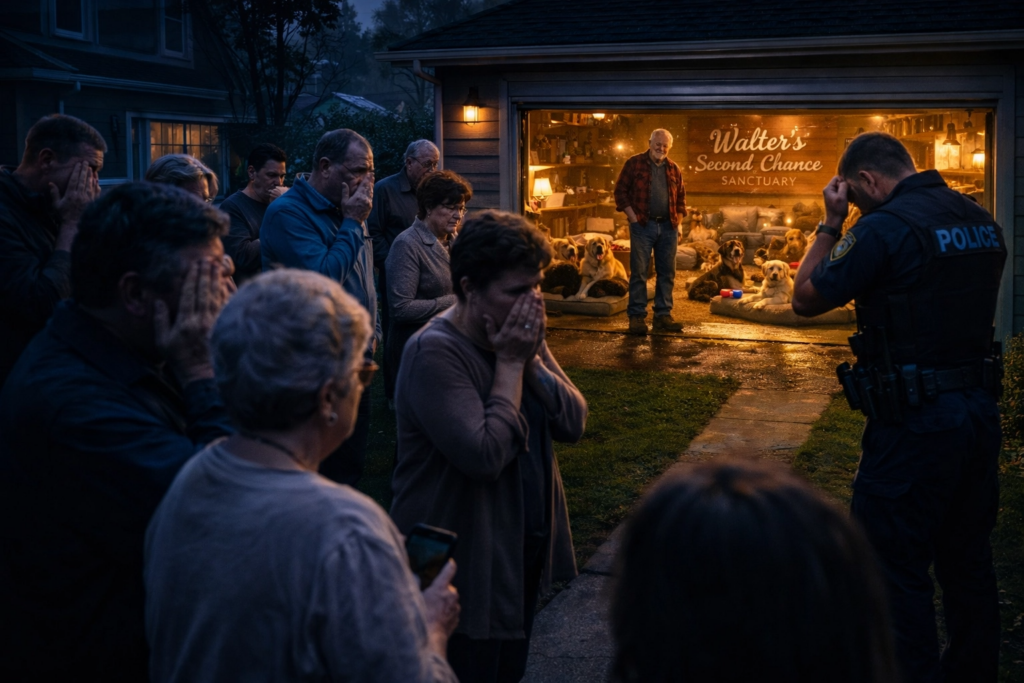
I’m Pete, 42. I’m married, blessed with two wonderful kids, and live three hours away. Every six months or so, I drive back to my hometown and stay with my dad for a few days. My dad, Walter, has lived alone since my mom passed away 26 years ago. He never remarried. Never sold the house.
And never changed the yellow curtains Mom picked for the kitchen, even after the sun faded them pale as old butter. Back then, I told myself Dad was managing fine, and maybe that was the lie I needed most. Dad was always moving. He’d be up before daylight. Boots on. Coffee down. And fixing fences for neighbors who barely thanked him. Then there was the garage. It had been off-limits for as long as I could remember. As a kid, I heard barking from behind that side door now and then. And suddenly, it would go quiet.
Dad would come out smelling like sawdust and dog shampoo and say, “Leave that one be, Pete.” I always did. Part of it was obedience. Part of it was fear. When I was nine, a pair of loose dogs chased me halfway down the street. They didn’t touch me, but I still remember my lungs burning and the slap of my sneakers on hot pavement. Ever since, barking behind a closed door made my shoulders lock up. Dad knew it. He never pushed. So I made the garage a rule: don’t go near it, don’t ask. That rule followed me into middle age. On my visits home, I’d see Dad disappear into that garage with bags from the feed store or blankets from town. Sometimes I’d hear nails tapping on concrete, a low whine, and the scrape of a bowl across the floor. Then, by evening, nothing. I didn’t ask where the dogs came from or where they went. I never bothered for years. Last Thursday morning
, Dad was standing at the sink when somebody started shouting from out front. “Walter, open the garage! Now! We know what you’ve been doing!” Dad frowned toward the window, then set his mug down and said, “Who on earth is calling for me this early?” By the time I stepped onto the porch behind him, our neighbor Mrs. Donnelly was already at the curb with her phone held chest-high, recording as if she’d been waiting her whole retirement for this moment. Mr. Grayson stood beside her. Mrs. Perez hovered near her mailbox, twisting her fingers together and watching the driveway. A county cruiser sat crooked near the curb. Two uniformed officers stood by the gate, one younger, one older with deep lines around his mouth. The younger one did the talking.
Dad walked down the porch steps in his work boots and flannel shirt. Mrs. Donnelly lifted her phone higher. “Tell them what you’ve been doing in that garage, Walter.” Dad didn’t look at her. “Morning to you too, Mrs. Donnelly.” Grayson muttered, “Don’t charm your way out of it, Walter. Admit it.” The younger county officer cleared his throat. “Sir, we’ve had multiple reports. Neighbors claim you’ve been bringing dogs home from shelters, and the animals come in but are never seen again. Some believe money may be involved.” Dad let out a short breath through his nose. “That’s the story now?” Mrs. Donnelly snapped, “We all see the same thing, Walter.” Mrs. Perez spoke up quietly. “I just said the barking would stop. I never said…” She trailed off when Mrs. Donnelly shot her a look.
I looked at Dad and found a flicker of doubt moving through me. I visited twice a year. I slept down the hall from that garage and never once opened the door. The older county officer stepped forward. “Walter, we need access to the garage.” “Do you have the paperwork?” Dad asked. The officer held up a folded sheet. “We do.” Dad nodded, reached into his pocket, pulled out his keys, and started toward the side of the house. Nobody spoke while he walked. The sound of those keys was the only thing I heard until Dad reached the garage and said, “All right, then. Watch close.” The door began to lift. A strip of shadow opened first, then a band of light. The younger officer stepped forward, ready for something ugly.
Mrs. Donnelly leaned around Grayson to get a better angle with her phone. The opening widened. The younger officer took two steps inside… and stopped. The older one moved in behind him. Then he just stood, startled the way people get when what they expected and what they found can’t fit in the same mind at once. There were no cages. No filth. No clutter. Just rows of wooden sleeping spaces, built by hand and sanded smooth, each one wide enough for a dog to stretch out comfortably. Every space had a folded blanket, a water bowl, a food dish, and a little framed photo set carefully against the back wall. Above each opening was a name painted in simple black letters, and beneath it a date. Daisy. 2004. Ranger. 2008. Millie. 2011. It didn’t feel like a garage. It felt like a room built for dignity. At the back stood a large board covered in photos. Dozens of dogs. Big dogs, little dogs, gray-faced old dogs, and shy-eyed mutts. Under each photo, in Dad’s neat block handwriting, were little notes: “Adopted after 11 months.” “Waited at shelter 417 days.” “Stayed here till the end.” These weren’t records. They were what tenderness looks like when it becomes routine. The whole thing was so gentle it made the accusation outside feel filthy. The younger officer whispered, his eyes glassy, “These aren’t missing dogs.” Dad stood behind me and answered in the same plain voice he used to ask if I wanted toast. “Nobody wanted the old ones.” That landed harder.
The older officer took off his hat. Outside, the yard had gone so quiet. Then Dad added, without raising his voice: “And I wasn’t going to let those poor creatures go without someone sitting with them at the end.” I kept walking as the room kept unfolding. There was a shelf in the corner holding collars, tags, and worn toys, each one labeled in masking tape with a name and year. A rubber duck. A frayed rope. A tennis ball gone soft with teeth marks. The kind of things you keep only when love has nowhere else to go On the workbench sat a stack of notebooks tied with twine. I picked up the top one and opened it: “Rosie ate half her supper. Hand-fed the rest. Benny likes the blue blanket better than the red one. Today, I sat up with Louie past midnight. Didn’t want him by himself.
Tucker had a good morning. Porch sun for 20 minutes. I stayed with Duke until he settled.” I pressed my thumb against the paper and couldn’t bring myself to flip the page right away. Twenty-six years of this. Dogs nobody picked. My father did it alone while I showed up twice a year with good intentions. “Why didn’t you tell me, Dad?” I asked. “I can help you set this up properly,” I added. “Make contacts. Build a better intake area. Talk to the shelters myself. You shouldn’t be carrying all of it alone anymore.” Dad glanced at Mom’s photo, then back at me.
“You sure?” I set the sandwich down. “Yeah. I’m sure.” *** The next morning, I pulled in with lumber stacked in the truck. Dad came into the garage and found me kneeling beside one of the sleeping spaces, holding a drill. “Just making room, Dad… in case one more furry soul needs a place.” He stopped in the doorway and nodded once, slow and full, the way a man nods when something turns out to be exactly what he needed. Turns out the dogs were never disappearing. They were loved Can you short this text please but not to much He shrugged once. “Wasn’t for telling.” “You built all this by yourself?” I turned to face him. Dad looked around the room as if I’d asked who painted the sky. “Took time, son… that’s all.” Behind me, the older officer asked carefully, “Sir, have you been working with shelters directly?” “A few,” Dad replied. “I take the dogs people pass over. The old ones… with cloudy eyes, stiff hips, and medicine schedules nobody wants to learn.” The officer pressed his lips together and looked down, wiping his eyes.