A serious aviation incident reportedly took place late Sunday night at New York’s LaGuardia Airport, raising significant safety concerns and temporarily disrupting operations at one of the nation’s busiest travel hubs.
Preliminary reports indicate that a regional passenger aircraft operated by Air Canada was involved in a ground collision with an airport emergency vehicle while moving along the runway after landing.
The aircraft, identified as a CRJ-900 regional jet, had just completed a scheduled flight from Montreal and was in the process of taxiing toward its assigned gate when the incident occurred.
According to early data, the plane was carrying between 80 and 100 passengers, along with crew members, all of whom experienced a sudden and alarming moment upon impact with the vehicle.
The collision is believed to have taken place shortly before 11:40 p.m. on Runway 4, a commonly used section of the airport that handles both arrivals and departures under controlled conditions.
Emergency response teams were immediately dispatched to the scene, as airport authorities worked quickly to assess the situation and ensure the safety of everyone involved in the incident.
Initial reports from U.S. media indicated that multiple individuals sustained injuries, including personnel associated with airport operations and emergency services present on the runway at the time.
Among those reportedly injured were two Port Authority personnel assigned to fire response duties, both of whom were transported to nearby hospitals for medical evaluation and treatment.
While early information suggested the possibility of critical injuries, officials have not confirmed the full extent or severity of all injuries, and updates have remained limited as investigations continue.
Some early media reports mentioned fatalities involving flight crew members; however, such claims have not been officially confirmed and should be treated with caution pending verified statements from authorities.
Air traffic control communications have become a key part of the ongoing investigation, with audio recordings suggesting that instructions were given to the emergency vehicle shortly before the collision occurred.
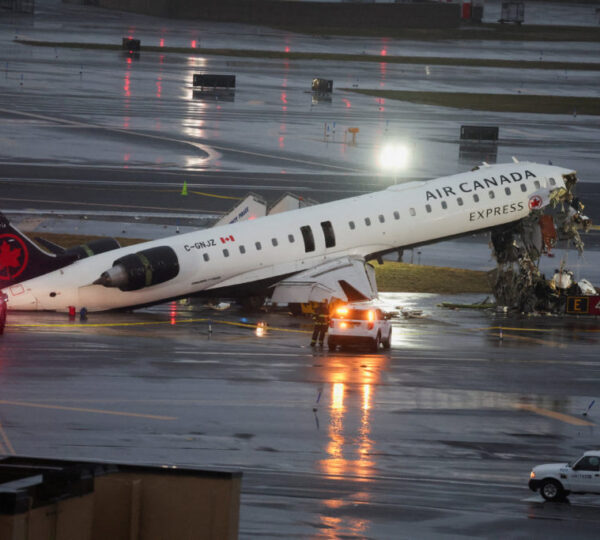
According to these recordings, controllers reportedly instructed the vehicle to stop multiple times, indicating a possible breakdown in coordination or timing between ground operations and aircraft movement.
One early line of inquiry focuses on whether the fire truck had received proper clearance to enter or cross the runway, which is a strictly regulated process requiring precise communication.
Aviation experts emphasize that runway incursions, although rare, are taken extremely seriously due to the potential risks they pose to both aircraft and ground personnel in active operational zones.
Weather conditions at the time of the incident may also have played a contributing role, as reports suggest that visibility and overall conditions were less than ideal late Sunday evening.
Reduced visibility can complicate both pilot awareness and ground vehicle navigation, especially in busy airport environments where multiple moving elements must be carefully coordinated at all times.
Following the collision, the Federal Aviation Administration implemented an immediate ground stop, temporarily halting all incoming and outgoing flights at LaGuardia Airport to prioritize safety and emergency response.
As a result of the shutdown, numerous flights were delayed or redirected to nearby airports, including John F. Kennedy International Airport and Newark Liberty International Airport.