t turns out that we might actually be only 80 percent “human”, as around a fifth of our DNA seems to have been donated to us by a mysterious hominin that diverged from our own lineage more than a million years ago. At some point before our ancestors left Africa, they interbred with this unknown species, contributing to a long and complicated series of affairs between separate hominin lineages.
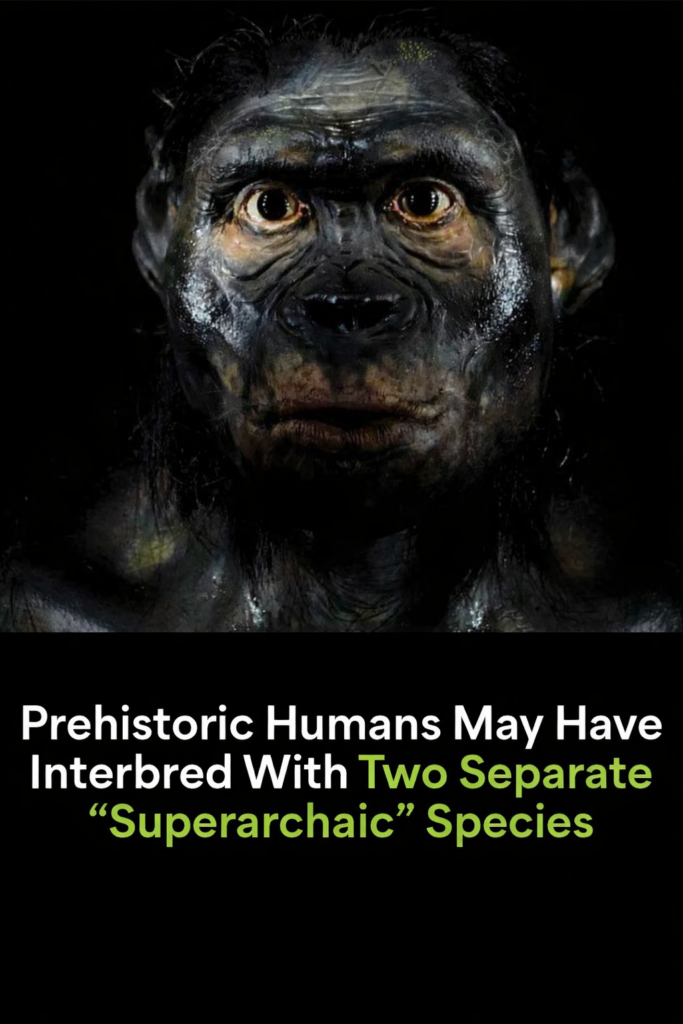
The culprit in this case is referred to as “superarchaic” because it separated from the modern human clade before we split from our closest “archaic” relatives, the Neanderthals and Denisovans. Recent genetic research has hinted at interbreeding between a superarchaic population and the African ancestors of all Homo sapiens, while it has also been shown that superarchaic hominins mated with the Eurasian ancestors of Neanderthals and Denisovans, before later hooking up with Denisovans themselves.
However, there remains some uncertainty over whether these admixture events all involved the same superarchaic population, or if multiple lovers were on the scene. Hoping to provide some clarity, researchers analyzed the distribution of genetic variants between modern humans, Neanderthals, and Denisovans in order to determine how much of their ancestry was shared.
Their findings – which have not yet been peer reviewed – indicate that two separate superarchaic populations took part in these prehistoric rendezvous. And while the researchers can’t say exactly when these episodes occurred, they were able to show that the hominin that interbred with European archaics diverged from the human lineage earlier than the species that mated with the ancestors of modern humans in Africa.
“Twenty percent is just a huge fraction,” said study author Professor Alan Rogers from the University of Utah. “When you get numbers like a 20-80 split, that’s more like a merger of two populations than a little bit of gene flow into an existing population,” he told IFLScience.
“It’s like modern humans are some kind of mosaic. They’re just a combination of two ancestries, neither of which was a small component of the total.”
The big question, of course, concerns the identity of these superarchaic contributors. Offering a hypothesis, the researchers note that Homo erectus first left Africa and spread across Eurasia around two million years ago, before the ancestors of Neanderthals and Denisovans embarked on their own Out-of-Africa expansion some 700,000 years ago.
“Those guys would have encountered the descendants of the original Out of Africa [group],” said Rogers. “So we think there was interbreeding between the ancestors of Neanderthals and Denisovans and these Homo erectus descendants in Eurasia.”
As for the superarchaic population that seduced our own ancestors, all we know is that this hominin diverged from our lineage about 1.3 million years ago, and that the interbreeding occurred before the split between modern Africans and Europeans. Beyond that, however, Rogers said “there are no suspects.”
A preprint version of the study is posted to bioRxiv.