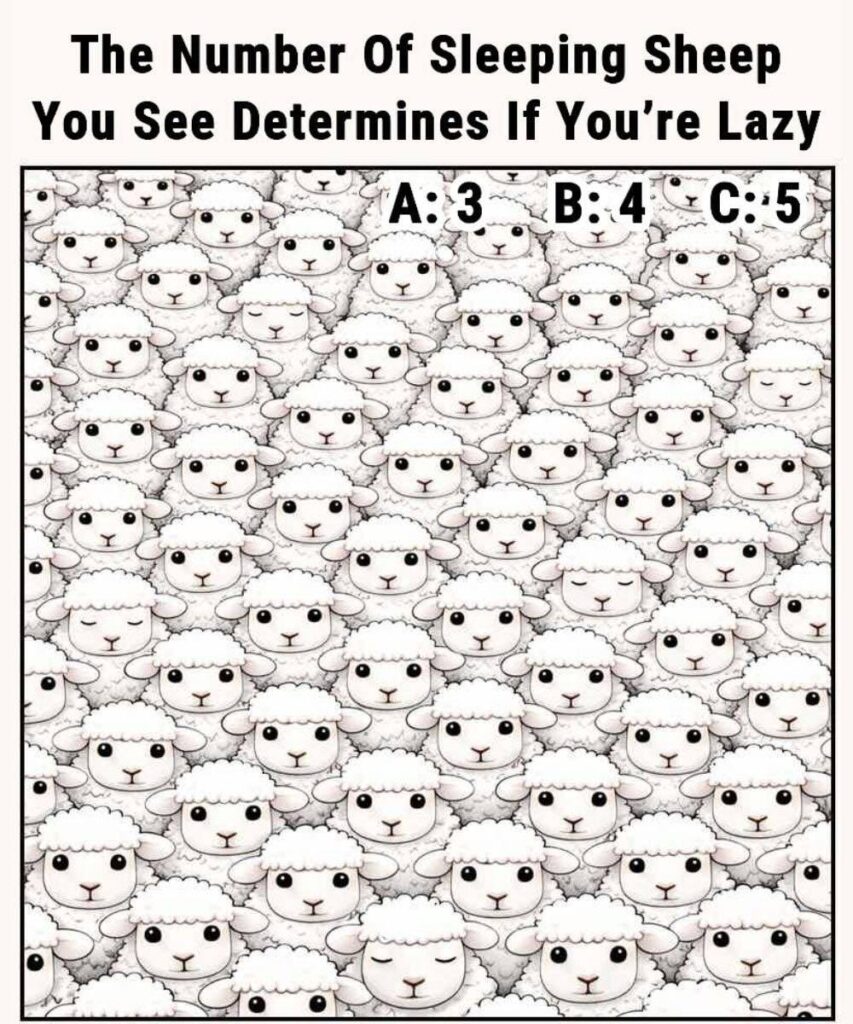
At first glance, a simple visual puzzle filled with nearly identical cartoon sheep might seem like nothing more than a quick distraction, something to pass a few idle moments. Yet these kinds of challenges tap into something much deeper about how the human mind processes information. When you look at a crowded image where most elements appear the same, your brain immediately begins searching for patterns. It tries to simplify what it sees, grouping similar shapes together so it can process the scene more efficiently. This is not a flaw; it is a feature of how cognition works. Without this ability, everyday tasks like reading, driving, or even recognizing faces would become overwhelming. In the case of the sheep puzzle, the repetition creates a sense of visual rhythm. Your mind relaxes into that rhythm, assuming uniformity, until something disrupts it. The sleeping sheep, with their closed eyes, represent that disruption. They are subtle enough to blend in, yet distinct enough to be noticed if you look closely. This balance between similarity and difference is what makes such puzzles engaging. They challenge the brain just enough to keep it interested, without making the task feel impossible. What seems like a playful test about “laziness” is actually an exploration of perception, attention, and the shortcuts the brain uses to navigate the world.
The idea that the number of sleeping sheep you find says something about your personality is meant to be taken lightly, but it does hint at real differences in how people approach tasks. Some individuals naturally scan quickly, focusing on the overall picture rather than the finer details. This approach can be highly efficient in many situations, allowing for rapid decision-making and adaptability. However, it may also lead to missing smaller, less obvious elements. Others take a more methodical approach, examining each part of the image carefully and deliberately. This can result in greater accuracy, but it often requires more time and mental effort. Neither style is inherently better; they simply reflect different cognitive strategies. In everyday life, both approaches have their advantages. Quick scanning can be useful in dynamic environments where speed is essential, while careful inspection is valuable in tasks that require precision. The puzzle brings these differences into focus in a way that feels accessible and even entertaining. By reflecting on how you approached the challenge, you gain a small insight into your own habits of attention. Did you rush to a conclusion once you spotted a few sleeping sheep, or did you continue searching to ensure you had found them all? That question, more than the actual number, reveals something meaningful about your thinking process.
What makes these visual challenges particularly compelling is their connection to a concept known as visual discrimination, a key aspect of how we interpret the world around us. Visual discrimination involves the ability to notice subtle differences between objects that are otherwise very similar. In the sheep puzzle, the difference between open and closed eyes is minimal, yet it is the defining feature that separates the “sleeping” sheep from the rest. Because the variation is so slight, your brain’s natural tendency is to overlook it, especially when it has already categorized the objects as identical. This is where the idea of cognitive efficiency comes into play. The brain is constantly trying to conserve energy, and one way it does this is by making assumptions based on patterns. If most of the sheep look the same, the brain assumes they all are, unless given a reason to think otherwise. This is not laziness in the traditional sense; it is an adaptive mechanism that allows us to function without being overwhelmed by detail. However, when a task requires breaking out of that pattern, such as finding the sleeping sheep, you must consciously override that automatic process. This shift from passive recognition to active observation is what turns a simple image into a mental exercise.
The playful interpretation of the results—whether you saw three, four, or five sleeping sheep—adds an element of personality to the experience, even if it is not scientifically grounded. It invites you to reflect on your tendencies in a lighthearted way, without attaching serious judgment. For instance, if you found fewer sheep, you might be someone who prioritizes efficiency and moves quickly through tasks, trusting your initial impressions. If you found more, you might lean toward thoroughness and attention to detail, taking the time to verify your observations. These interpretations are not definitive, but they can spark self-awareness. They remind us that the way we approach even a small puzzle mirrors how we approach larger challenges. Do we settle for “good enough,” or do we push for completeness? Do we trust our instincts, or do we double-check our assumptions? These are questions that extend far beyond a field of cartoon sheep. They influence how we solve problems, make decisions, and interact with the world. By framing these ideas in a playful context, the puzzle makes them easier to explore without pressure or judgment.
Another reason these puzzles are so engaging is that they provide immediate feedback. Unlike more complex tasks that require long periods of effort before yielding results, a visual challenge like this offers a quick sense of accomplishment. You either find the sleeping sheep or you don’t, and you can easily go back and look again. This ability to revisit the task encourages persistence and curiosity. You might initially think you have found all the sleeping sheep, only to discover another one upon closer inspection. This moment of realization can be surprisingly satisfying, reinforcing the idea that careful observation can reveal what was previously hidden. It also highlights the limitations of first impressions. In many areas of life, we rely heavily on initial judgments, often without questioning them. Puzzles like this gently challenge that habit, ցույցing that there is often more beneath the surface if we take the time to look. They encourage a mindset of curiosity rather than certainty, where the goal is not just to find the answer, but to understand how you arrived at it.
In the end, the true value of this kind of challenge lies not in the number of sleeping sheep you identify, but in the awareness it creates. It reminds you that perception is not always as straightforward as it seems, and that the brain’s shortcuts, while useful, can sometimes lead to incomplete conclusions. It also reinforces the idea that attention is a skill that can be developed. By practicing tasks that require focus and observation, you can train your mind to notice details more effectively over time. This does not mean abandoning efficiency, but rather balancing it with intentional awareness. The puzzle serves as a small but meaningful exercise in this balance, ցույցing that slowing down can reveal new layers of understanding. Ultimately, whether you found three, four, or five sleeping sheep is less important than the process you used to find them. That process reflects how you engage with the world—whether you move quickly or carefully, whether you trust patterns or question them. And in recognizing those tendencies, you gain a deeper appreciation for the complexity of your own mind, which is anything but lazy .